
It has only been a few hours, as of publishing this piece, since all seven members of BTS announced via Instagram Story that they’ve chosen not to proceed with submitting their latest album, ARIRANG, to the Grammys for consideration.
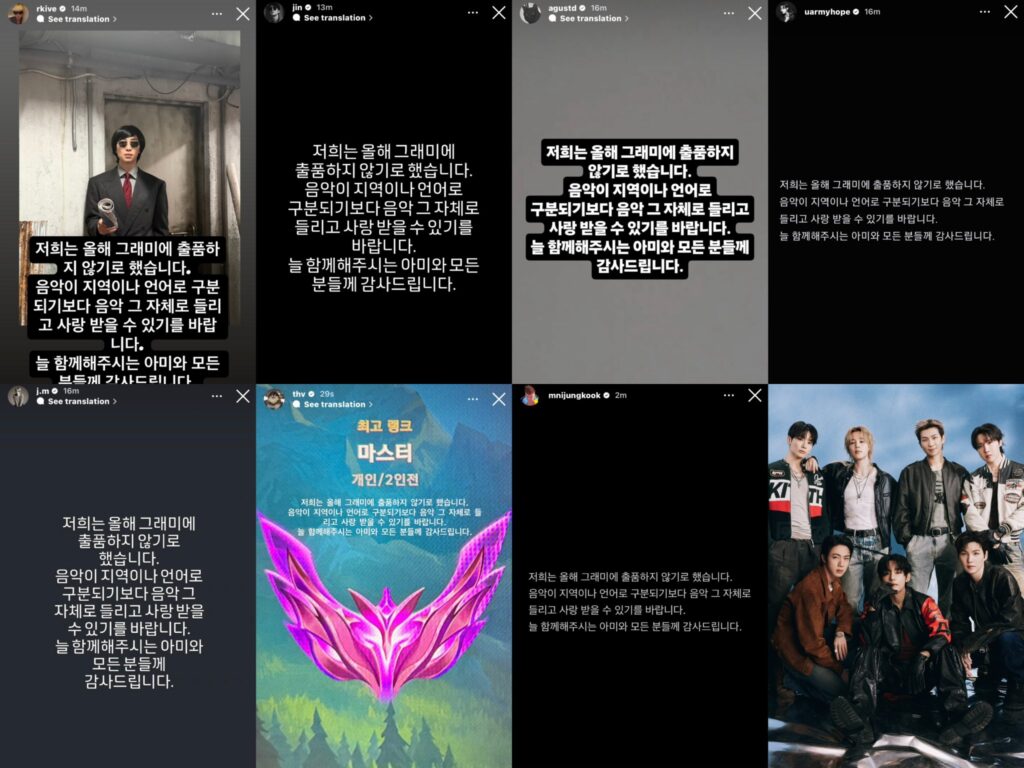
The statement reads:
“We have decided not to submit to the Grammys this year. We hope that music can be heard and loved for its own sake, rather than being distinguished by region or language. Thank you to ARMY and everyone who is always with us.”
This has been unlike previous instances, such as their multi-week chart-topping singles Dynamite (released in 2020) and Butter (released in 2021), where they actively sought to present their work to the Grammys. But this announcement today was not sudden by any means. It is a response to the Western music industry’s repeated efforts to marginalize and isolate non-white and non-English-speaking artists and contain them in a box with ever-creative, fancy labels. It is a response to xenophobia.
This phenomenon was most recently committed by the Recording Academy. In June 2026, it introduced its new category, Best Asian Pop Music Performance, aimed at artists from China, Japan, and Korea. What’s interesting about this category is that not only is it a form of containment for East Asian artists, but by calling it Asian and not including other regions of Asia, the Academy committed a double blunder, re-establishing the long-held belief that Western nations consider only East Asian countries as “Asian.” But if you still haven’t caught on to what this move aims to achieve, then let me verbalize it for you: it risks excluding music from East Asia from any of the main categories. And if you ever thought your favourite artist from this region deserved to be nominated for Song of the Year or maybe Album of the Year because of how amazing their music is, then the Grammys just created a system to make sure that does not happen.
And it is all the more interesting when you put this new rule by the Grammys in the context of what’s happening for Korean music. BTS, the biggest music group in South Korea, released their highly anticipated comeback album ARIRANG after a group break of approximately two years due to their mandatory South Korean military enlistment. Released on March 20, 2026, the album sold a staggering 3.98 million copies on its release day and debuted at No. 1 on the Billboard 200. The lead single from the album, SWIM, became the fastest song of the year to reach 100 million streams on Spotify in just eight days after its release and topped the Billboard Hot 100 chart dated April 4, 2026. The group is currently in the middle of their biggest tour yet, the BTS World Tour ARIRANG, which is sold out in every city where it is scheduled, projecting it to become one of the biggest concert tours witnessed in the global music industry to date.
By all standards, BTS are strongly positioned to win one of the main categories at the upcoming Grammys. Their album success and astounding tour speak for themselves. BTS’ success is loud enough for the Grammys to panic and mete out an absurd category to prevent them from contending for the main awards, not just for now, but forever. And they even ensured that no other East Asian artist gets close to being nominated for the main ones.
BTS are no strangers to the West’s repeated attempts to discredit them. From hearing interviewers call their fans 15-year-olds to being wrongly accused and questioned over their fans’ streaming behaviour, BTS have often witnessed the industry try to strip away their accolades, albeit unsuccessfully, while still trying to profit from the viewership they draw. Funnily enough, the very Grammys that repeatedly shied away from presenting them with a much-deserved award in the past received a massive share of their social media traffic owing to the group’s Butter performance.

In view of this, a quote from Bryan Rolli for Forbes seems to be a befitting conclusion:
“But as BTS continue smashing records and the Grammys continue to lose relevance, who really needs who?”
Leave a Reply